
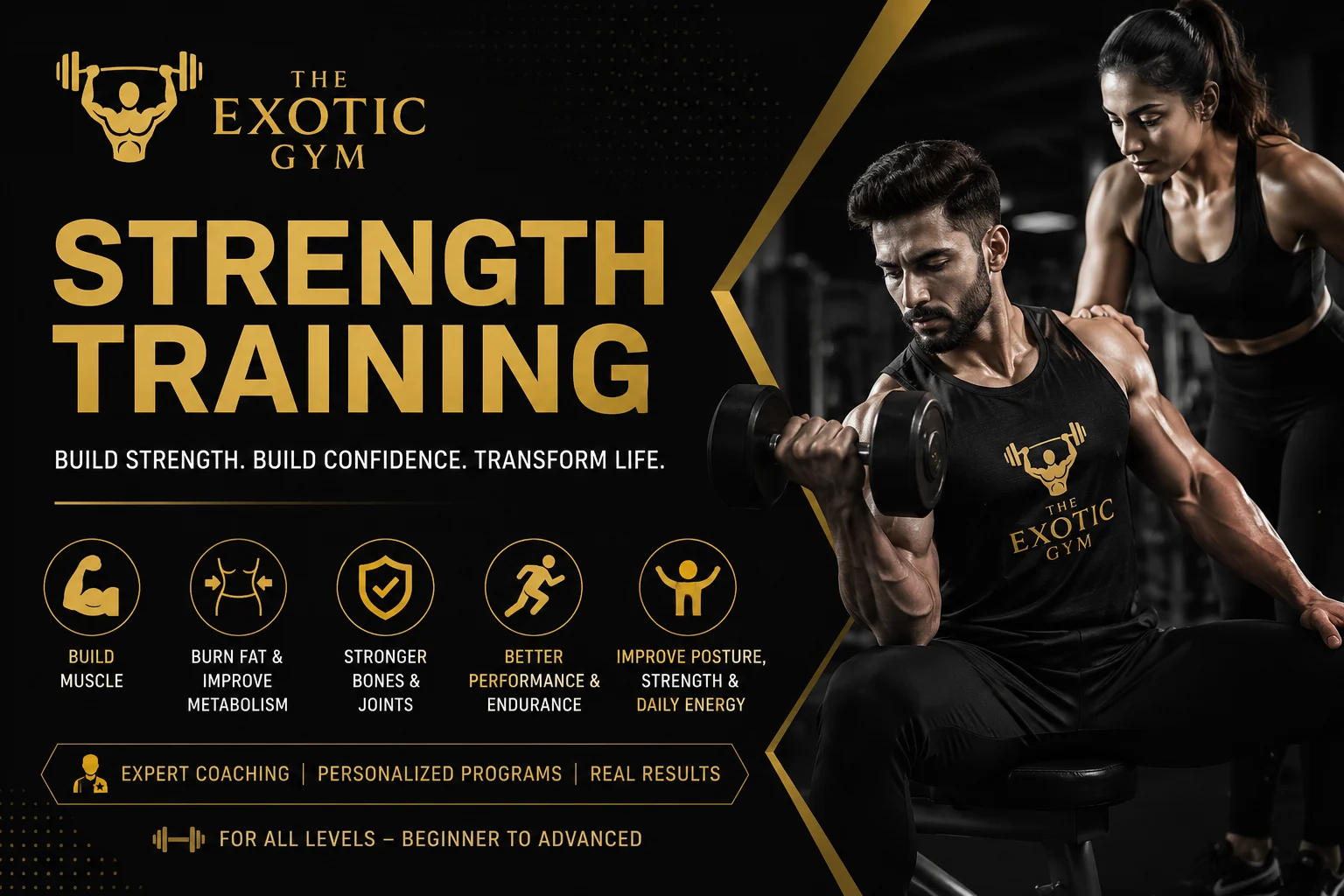
Strength Training in Sonipat: Why Building Strength Is Essential for Long-Term Fitness
Many people begin their fitness journey with a simple goal—lose a few kilograms, improve their appearance, or become more active. While these are excellent reasons to join a gym, one of the most valuable investments you can make in your health is building strength.
Strength training is often misunderstood. Some believe it is only for bodybuilders or athletes who lift heavy weights. Others worry that it will make them bulky or is unsuitable for beginners. In reality, Strength Training is one of the most effective forms of exercise for people of all ages and fitness levels. Whether you're a student, working professional, homemaker, or senior looking to stay active, a structured strength training program can improve both physical performance and overall health.
At The Exotic Gym, strength training is not simply about lifting heavier weights. It focuses on improving movement quality, increasing muscle strength, enhancing endurance, supporting fat loss, and building a healthier body that performs better in everyday life.
What Is Strength Training?
Strength Training is a form of exercise that uses resistance to improve muscle strength, endurance, stability, and overall physical performance. Resistance may come from free weights, barbells, dumbbells, resistance machines, cables, kettlebells, or even bodyweight exercises.
The primary objective is to gradually challenge your muscles so they adapt and become stronger over time. This process, known as progressive overload, helps improve not only muscle strength but also coordination, balance, posture, and functional fitness.
Unlike random gym workouts, a structured Strength Training Program follows a planned progression that allows your body to improve safely and consistently.
Who Should Do Strength Training?
One of the biggest misconceptions is that strength training is only suitable for experienced lifters.
In reality, almost everyone can benefit from it.
Beginners
Individuals starting their fitness journey develop proper movement patterns, improve coordination, and gain confidence while learning correct exercise techniques.
Working Professionals
Long hours at a desk often lead to poor posture, reduced mobility, and muscular imbalances. Strength training helps strengthen weak muscles, improve posture, and reduce everyday aches and stiffness.
Weight Loss Seekers
A well-designed Strength Training Workout helps preserve lean muscle while increasing calorie expenditure, making it an effective addition to any weight loss plan.
Athletes
Athletes use strength training to improve speed, power, endurance, stability, and overall sports performance while reducing injury risk.
Older Adults
Maintaining muscle strength becomes increasingly important with age. Regular resistance training supports joint health, balance, bone density, and independence in daily activities.
Regardless of age or experience, structured Strength Training in Sonipat can be adapted to suit individual fitness levels and personal goals.
Why Strength Matters Beyond the Gym
Strength is not only measured by how much weight you can lift.
It influences almost every daily activity.
Simple tasks such as:
-
Carrying grocery bags
-
Climbing stairs
-
Lifting children
-
Moving furniture
-
Standing for long periods
all become easier when your muscles are stronger.
Improved strength also supports better posture, balance, coordination, and mobility, making everyday movement more comfortable and efficient.
Building Lean Muscle Safely
Muscle development is one of the most noticeable benefits of strength training, but it doesn't happen overnight.
A structured Strength Building Program focuses on gradual progression rather than excessive weight lifting.
Training typically includes:
-
Compound exercises
-
Isolation movements
-
Progressive resistance
-
Controlled technique
-
Adequate recovery
This balanced approach helps develop lean muscle while minimizing the risk of injury.
For beginners, learning proper technique is far more important than lifting heavy weights.
Strength Training Supports Healthy Weight Management
Many people associate fat loss only with cardio workouts.
However, resistance training plays an equally important role.
Building lean muscle increases the body's energy requirements, meaning more calories are used throughout the day—even during rest.
A professionally designed Strength Training for Weight Loss program often combines:
-
Resistance exercises
-
Functional movements
-
Cardiovascular activity
-
Progressive intensity
-
Recovery planning
This combination supports sustainable fat loss while preserving valuable muscle tissue.
Rather than simply reducing body weight, the focus shifts toward improving body composition.
Improving Bone and Joint Health
Strength training benefits far more than muscles.
Regular resistance exercise helps place healthy stress on bones, encouraging them to remain strong over time.
Additional benefits include:
-
Improved joint stability
-
Better movement control
-
Increased flexibility
-
Enhanced balance
-
Reduced risk of age-related bone loss
When exercises are performed correctly under professional supervision, they contribute to long-term musculoskeletal health.
Reducing the Risk of Injuries
Many injuries occur because muscles surrounding the joints are weak or because movement patterns are poor.
A structured Strength Training Fitness Program emphasizes proper technique before increasing workout intensity.
Training focuses on:
-
Correct posture
-
Controlled movement
-
Core stability
-
Balanced muscle development
-
Progressive resistance
These improvements help reduce unnecessary stress on joints while supporting safer movement during sports, work, and daily activities.
Structured Training Produces Better Results
Following random workouts often leads to inconsistent progress.
Some days people focus only on arms.
Other days they perform excessive cardio or repeat the same exercises for weeks.
A structured Personal Strength Training program eliminates this uncertainty.
Each workout is planned according to:
-
Current fitness level
-
Strength capacity
-
Recovery ability
-
Individual goals
-
Progressive improvement
As your body becomes stronger, workouts evolve to maintain steady progress.
This systematic approach helps prevent fitness plateaus while improving overall performance.
Why Professional Guidance Makes a Difference
Learning proper exercise technique early can save months of frustration.
A Strength Training Coach helps members:
-
Master lifting techniques
-
Select appropriate exercises
-
Adjust workout intensity
-
Improve posture
-
Monitor progress
-
Prevent common training mistakes
Professional coaching ensures workouts remain both safe and effective, especially for beginners who may be unfamiliar with resistance training.
Rather than guessing which exercises to perform, members follow a clear path designed around their goals.
Strength Training Builds Confidence
The physical improvements from strength training are often accompanied by mental benefits.
As strength increases, many people notice improvements in:
-
Confidence
-
Self-discipline
-
Motivation
-
Energy levels
-
Stress management
Successfully lifting more weight, completing challenging workouts, or achieving personal milestones creates a strong sense of accomplishment that extends beyond the gym.
This confidence often carries into work, studies, sports, and daily life.
Long-Term Fitness Requires Consistency
Quick fitness trends often promise dramatic transformations within a few weeks.
Lasting results rarely happen that way.
Strength training is most effective when viewed as a long-term investment rather than a short-term challenge.
Consistent training helps individuals:
-
Build lean muscle
-
Improve strength
-
Increase endurance
-
Enhance mobility
-
Support healthy aging
-
Maintain functional independence
These benefits continue accumulating over months and years, creating a healthier and more resilient body.
Why Strength Training Is the Foundation of Better Fitness
Every successful fitness journey begins with building a strong foundation. Whether your goal is weight loss, muscle gain, improved athletic performance, or better overall health, strength training provides the stability needed to achieve lasting results.
A professionally designed Strength Training Program combines expert coaching, progressive workouts, proper exercise techniques, and continuous improvement to help individuals train safely and effectively. Instead of focusing only on lifting heavier weights, structured strength training develops stronger muscles, healthier joints, improved posture, greater confidence, and the physical ability to enjoy everyday life with more energy and less limitation.
No matter where you begin, building strength today creates a healthier tomorrow.
Benefits of Strength Training Beyond Muscle Building: Fat Loss, Bone Health, and Daily Performance
When people hear the words Strength Training, they often picture bodybuilders lifting heavy barbells or athletes preparing for competitions. While building muscle is certainly one benefit, it represents only a small part of what strength training can do.
Today, doctors, physiotherapists, sports professionals, and fitness coaches widely recommend strength training because of its long-term impact on overall health. Whether your goal is to lose weight, improve posture, increase energy, or simply make everyday activities easier, regular resistance training offers benefits that extend far beyond appearance.
A professionally designed Strength Training Program helps develop a stronger body, healthier joints, better movement, and improved physical confidence. It supports people of every age—from beginners taking their first steps toward fitness to experienced gym members looking to improve performance.
Strength Training Does More Than Build Muscle
Muscles naturally become stronger when challenged through resistance exercises. However, those stronger muscles also create positive changes throughout the body.
Regular Strength Training contributes to:
-
Improved metabolism
-
Better body composition
-
Stronger bones
-
Enhanced posture
-
Greater mobility
-
Increased energy
-
Improved balance
-
Better everyday performance
Rather than focusing only on lifting heavier weights, structured training develops a body that functions more efficiently in both the gym and daily life.
Strength Training Helps Increase Metabolism
One of the biggest reasons people include resistance exercise in their fitness routine is its positive effect on metabolism.
Muscle tissue requires more energy to maintain than body fat. As lean muscle gradually increases through consistent Muscle Strength Training, the body becomes more efficient at using calories throughout the day.
While strength training is not a shortcut to weight loss, it supports healthy calorie expenditure by:
-
Increasing lean muscle mass
-
Improving workout intensity
-
Supporting long-term energy balance
-
Helping maintain metabolic efficiency
Combined with sensible nutrition and regular physical activity, strength training becomes an effective part of a sustainable fitness plan.
Supporting Healthy Fat Loss
Many people rely exclusively on cardio workouts when trying to lose weight.
Although cardiovascular exercise plays an important role, Strength Training for Weight Loss offers additional advantages.
Resistance training helps preserve muscle while encouraging fat reduction.
This is important because losing muscle along with body fat may reduce overall strength and make it harder to maintain long-term results.
A balanced program often combines:
-
Strength training exercises
-
Functional movements
-
Cardiovascular sessions
-
Mobility work
-
Recovery
The result is gradual fat loss while maintaining a stronger and healthier body.
Instead of focusing only on the number displayed on the weighing scale, attention shifts toward improving body composition.
Building Stronger Bones
Bone health becomes increasingly important as we age.
Just like muscles, bones respond positively to regular physical activity.
Resistance exercises encourage the body to maintain healthy bone strength by placing controlled stress on the skeletal system.
Consistent Strength Training may contribute to:
-
Improved bone density
-
Better joint stability
-
Increased structural strength
-
Reduced risk of age-related bone weakness
For adults of all ages, maintaining strong bones supports long-term independence and physical confidence.
Better Posture Through Balanced Strength
Modern lifestyles often involve long hours sitting at desks, driving, or using digital devices.
Over time, these habits may contribute to:
-
Rounded shoulders
-
Weak core muscles
-
Tight hips
-
Neck discomfort
-
Lower back pain
A structured Strength Training Fitness Program strengthens muscles responsible for maintaining proper posture.
Exercises targeting the back, shoulders, core, and hips help restore muscular balance while improving alignment during daily activities.
Many individuals notice they naturally stand taller and move more comfortably after several weeks of consistent training.
Increased Energy Throughout the Day
Regular exercise may seem tiring at first, but over time it often produces the opposite effect.
As strength improves, everyday activities require less effort.
Simple tasks such as:
-
Carrying shopping bags
-
Walking upstairs
-
Lifting household items
-
Playing with children
-
Standing for long periods
become noticeably easier.
Many people also report improved concentration and reduced feelings of fatigue after making strength training part of their weekly routine.
Greater physical capacity often leads to greater confidence in everyday life.
Functional Fitness for Real-Life Movement
Fitness should improve more than gym performance.
It should improve how your body functions outside the gym.
Functional Strength Training focuses on movement patterns that support everyday activities.
Instead of training muscles in isolation, exercises improve:
-
Balance
-
Coordination
-
Stability
-
Flexibility
-
Joint control
-
Movement efficiency
These improvements help individuals move more comfortably during work, sports, travel, and daily responsibilities.
Functional fitness is one reason strength training benefits people of all ages—not only competitive athletes.
Improved Athletic Performance
Athletes across different sports regularly include strength training in their programs because stronger muscles improve overall performance.
Benefits may include:
-
Increased power
-
Better speed
-
Improved endurance
-
Enhanced coordination
-
Faster movement efficiency
Whether someone enjoys cricket, football, running, cycling, or recreational sports, a professionally designed Strength and Conditioning Training program can support better physical performance while reducing the likelihood of common sports injuries.
Better Joint Stability and Injury Prevention
Weak muscles often place additional stress on joints.
Strength training helps build the muscles surrounding major joints such as:
-
Knees
-
Hips
-
Shoulders
-
Ankles
Stronger supporting muscles improve stability and movement control.
When combined with proper exercise technique, this helps reduce unnecessary strain during workouts and everyday activities.
A Strength Training Coach also teaches correct lifting mechanics, helping beginners avoid common mistakes that may lead to injuries.
Improved Mental Well-Being
Physical improvements are only part of the story.
Many individuals experience positive mental changes as strength increases.
Regular Strength Training often contributes to:
-
Greater self-confidence
-
Improved discipline
-
Better stress management
-
Higher motivation
-
Increased sense of achievement
Completing challenging workouts, achieving personal bests, and seeing measurable progress create confidence that extends beyond fitness.
These positive experiences often influence work, studies, and everyday life.
Long-Term Health Benefits
The true value of strength training becomes even more noticeable over time.
Maintaining strength supports healthy aging by helping people remain active, independent, and physically capable.
Long-term benefits include:
-
Better mobility
-
Improved balance
-
Stronger muscles
-
Healthier bones
-
Greater functional independence
-
Higher quality of life
Rather than being a short-term fitness trend, strength training becomes an investment in future health.
Why Consistency Produces Lasting Results
The benefits of Progressive Strength Training are not achieved through occasional workouts.
They develop gradually through consistent effort.
Training two to four times each week, following structured progression, and allowing proper recovery creates steady improvements over months and years.
Small gains accumulate into significant changes.
Stronger muscles become better movement.
Better movement becomes greater confidence.
Greater confidence encourages long-term commitment to a healthier lifestyle.
Strength Training Is About Living Better, Not Just Looking Better
Many people begin strength training hoping to improve their appearance. What often surprises them is how much better they feel in everyday life.
A professionally designed Strength Training Program helps improve metabolism, supports healthy fat loss, strengthens bones, enhances posture, increases daily energy, and develops functional fitness that benefits every aspect of life. Combined with proper coaching and consistent practice, resistance training creates a stronger body that not only performs better in the gym but also supports healthier movement, greater confidence, and long-term physical well-being.
The goal isn't simply to lift heavier weights. The real achievement is building a body that stays strong, capable, and healthy for years to come.
Personalized Strength Training Programs: How Customized Workouts Deliver Better Results
Walk into any gym during peak hours and you'll notice something interesting. Several people may be using the same equipment, following similar exercises, and spending nearly the same amount of time working out. Yet after a few months, their results often look completely different.
One person becomes stronger and leaner. Another builds noticeable muscle. Someone else struggles to make progress despite putting in equal effort.
The difference is rarely determination alone.
The biggest factor is whether the workout matches the individual.
Every person has a unique body, fitness history, recovery ability, and personal goal. A workout designed for a competitive powerlifter will not produce the same results for someone trying to lose weight or improve everyday fitness. This is why a Personalized Strength Training Program consistently delivers better results than following generic routines found online or copied from other gym members.
A customized program adapts to your body, your goals, and your progress, making every workout more effective and sustainable.
Why Generic Workout Plans Often Fail
The internet offers thousands of free workout plans promising rapid transformations.
Although these routines may work for some people, they rarely consider the factors that make every individual different.
Generic programs usually ignore:
-
Current strength level
-
Body composition
-
Age
-
Training experience
-
Recovery capacity
-
Lifestyle
-
Previous injuries
-
Personal fitness goals
Following the wrong program may lead to:
-
Slow progress
-
Poor exercise selection
-
Overtraining
-
Reduced motivation
-
Increased injury risk
A professionally designed Strength Training Program removes this uncertainty by focusing entirely on the individual.
Every Body Responds Differently to Training
No two people begin their fitness journey from exactly the same place.
Some individuals naturally build muscle faster.
Others respond better to endurance-based workouts.
Some have excellent mobility, while others require additional flexibility and stability work before progressing.
A Strength Training Coach considers factors such as:
Fitness Level
Beginners require different exercise intensity than experienced lifters.
Body Type
Workout structure often varies depending on body composition and physical development.
Lifestyle
Someone with a physically demanding job may recover differently than someone working at a desk throughout the day.
Recovery Capacity
Sleep, stress, nutrition, and activity levels all influence how quickly the body adapts to training.
Understanding these differences allows every workout to be tailored for maximum effectiveness.
Goal-Based Coaching Produces Better Results
Every person joins a gym with a different objective.
Common goals include:
-
Weight loss
-
Muscle building
-
Strength development
-
Improved athletic performance
-
Better posture
-
Increased endurance
-
Overall health improvement
Each goal requires a different training strategy.
For example:
Someone following Strength Training for Weight Loss may combine resistance exercises with functional movements and moderate cardiovascular activity.
A person aiming for muscle development may require greater training volume, progressive resistance, and longer recovery periods.
Rather than following a one-size-fits-all routine, Personal Strength Training creates a program built specifically around the individual's priorities.
Personalized Workout Plans Improve Training Efficiency
Many people spend hours in the gym without a clear purpose.
They move from one machine to another, repeating exercises without understanding how they contribute to long-term progress.
A Customized Strength Training Program provides structure.
Each session has a defined purpose.
Training may include:
Compound Lifts
Exercises such as squats, deadlifts, bench presses, and rows build overall strength by working multiple muscle groups simultaneously.
Accessory Exercises
Target smaller muscle groups to improve balance and support major lifts.
Functional Movements
Develop coordination, stability, and real-life movement efficiency.
Mobility and Recovery
Improve flexibility while preparing the body for future training sessions.
Every exercise contributes to a larger progression rather than existing as an isolated workout.
Progressive Strength Development
One of the key principles behind successful Strength Training is progressive overload.
As your body becomes stronger, your workouts must gradually evolve.
Progression may include:
-
Increasing resistance
-
Performing additional repetitions
-
Improving lifting technique
-
Increasing training volume
-
Introducing more challenging movement patterns
This gradual progression encourages continuous improvement while reducing unnecessary strain on muscles and joints.
Without progression, the body eventually adapts, and results begin to slow.
Continuous Progress Tracking
A personalized training program doesn't end after the first workout plan is created.
Regular evaluations help ensure progress continues.
A Strength Training Personal Trainer may monitor:
-
Strength improvements
-
Workout performance
-
Body measurements
-
Body composition
-
Movement quality
-
Recovery
Tracking these indicators helps identify when workouts should be adjusted.
Instead of continuing the same routine for months, training evolves alongside your growing strength and fitness.
Personalized Coaching Improves Exercise Technique
Correct lifting technique is one of the most valuable aspects of professional coaching.
Poor exercise form often leads to:
-
Reduced muscle activation
-
Slower progress
-
Joint discomfort
-
Increased injury risk
A Certified Strength Trainer provides immediate feedback during each workout.
Small adjustments to posture, grip, movement speed, or lifting mechanics often produce significant improvements in both safety and performance.
Learning proper technique early creates a foundation for long-term success.
Preventing Fitness Plateaus
Almost everyone reaches a stage where progress slows.
This is completely normal.
The body naturally adapts to repeated exercise.
A personalized Strength Training Fitness Program prevents plateaus by introducing strategic changes such as:
-
New exercise variations
-
Increased resistance
-
Different training splits
-
Modified repetition ranges
-
Improved recovery strategies
These adjustments continue challenging the body without sacrificing safety.
Motivation Through Individual Progress
One advantage of One-on-One Strength Training is the ability to measure progress against your own previous performance rather than comparing yourself with others.
Each improvement matters.
Examples include:
-
Lifting slightly heavier weights
-
Completing additional repetitions
-
Improving exercise technique
-
Feeling stronger during daily activities
-
Recovering more efficiently
These small achievements build confidence and encourage long-term consistency.
Fitness becomes a personal journey rather than a competition.
Personalized Coaching Supports Long-Term Success
A successful Strength Building Program extends beyond individual workouts.
Professional coaching also helps members develop habits that support long-term health.
These include:
-
Consistent training schedules
-
Realistic goal setting
-
Balanced recovery
-
Gradual progression
-
Sustainable lifestyle changes
Instead of relying on temporary motivation, members learn how to make strength training a regular part of everyday life.
Why Customized Strength Training Delivers Better Results
The best workout isn't the one followed by the most people.
It's the one designed specifically for you.
A professionally developed Personalized Strength Training Program considers your current fitness level, body type, experience, lifestyle, and long-term goals before creating a structured plan that evolves as you improve.
Through individualized coaching, progressive strength development, continuous progress tracking, and expert exercise guidance, personalized training helps members achieve better results than generic gym routines. Whether the goal is building muscle, improving strength, losing body fat, or enhancing overall fitness, customized coaching provides a smarter, safer, and more effective path toward lasting success.
Common Strength Training Mistakes That Slow Your Progress and How to Avoid Them
Starting a Strength Training Program is an excellent step toward improving your health, building muscle, and becoming physically stronger. However, many people put in weeks or even months of hard work without seeing the results they expected. The problem is rarely a lack of effort. More often, it's the small mistakes repeated during every workout.
Strength training is not simply about lifting heavier weights. It's about following the right technique, training consistently, recovering properly, and gradually challenging your body. Ignoring these fundamentals can slow progress, increase the risk of injuries, and make workouts feel frustrating instead of rewarding.
The good news is that most of these mistakes are completely avoidable. Understanding them early can help you train smarter, stay consistent, and achieve better long-term results.
Mistake #1: Prioritizing Heavy Weights Over Proper Technique
One of the most common mistakes in the gym is trying to lift more weight before mastering the exercise.
Many beginners assume heavier weights automatically produce better results. In reality, poor lifting technique often reduces muscle activation while placing unnecessary stress on joints and connective tissues.
Common examples include:
-
Rounded backs during deadlifts
-
Half squats instead of full range of motion
-
Using momentum instead of muscle control
-
Incorrect shoulder positioning during pressing exercises
A Strength Training Coach always focuses on movement quality before increasing resistance.
Learning proper technique allows muscles to work efficiently while greatly reducing the chance of injury.
Mistake #2: Lifting More Than Your Body Can Control
It can be tempting to compare yourself with experienced gym members.
Trying to match someone else's lifting weight often leads to poor form and unnecessary strain.
Signs that the weight is too heavy include:
-
Loss of balance
-
Incomplete repetitions
-
Swinging the body during lifts
-
Holding your breath excessively
-
Sudden loss of technique
Progress comes from gradually challenging your muscles—not from lifting the heaviest weight possible.
A structured Strength Training Program increases resistance only after your technique remains consistent.
Mistake #3: Training Without a Structured Plan
Walking into the gym without knowing what to train often leads to random workouts.
One session focuses entirely on arms.
The next workout becomes mostly cardio.
Another day involves repeating yesterday's exercises.
This lack of direction makes progress difficult.
A professional Strength Building Program organizes workouts according to:
-
Training goals
-
Muscle recovery
-
Exercise progression
-
Weekly schedule
-
Long-term development
Every workout becomes part of a larger plan rather than an isolated session.
Mistake #4: Being Inconsistent with Training
Strength is built through repetition over time.
Many people train intensely for one or two weeks before losing motivation.
Others skip workouts because of work, travel, or temporary fatigue.
Missing occasional sessions is normal.
The problem begins when inconsistency becomes a habit.
A sustainable Strength Training Fitness Program fits around your lifestyle rather than expecting perfection.
Training consistently two or three times every week for several months will usually produce better results than exercising daily for only a few weeks.
Mistake #5: Skipping Recovery
Many people believe muscles grow during workouts.
In reality, muscles recover and become stronger after training.
Ignoring recovery may lead to:
-
Constant soreness
-
Reduced performance
-
Fatigue
-
Lack of motivation
-
Increased injury risk
Recovery should include:
-
Adequate sleep
-
Balanced nutrition
-
Hydration
-
Rest days
-
Stretching and mobility work
Professional coaches understand that recovery is part of training, not a break from it.
Mistake #6: Not Following Progressive Overload
The human body adapts quickly to exercise.
Repeating the same workout with the same weight month after month eventually leads to slower progress.
Successful Progressive Strength Training gradually increases training demands through:
-
Slightly heavier resistance
-
Additional repetitions
-
More training volume
-
Improved exercise control
-
New movement variations
Progress does not always require dramatic changes.
Small improvements made consistently often produce the best long-term results.
Mistake #7: Ignoring Warm-Up Sessions
Many gym members head straight to heavy lifting without preparing their muscles.
A proper warm-up helps:
-
Increase blood flow
-
Improve joint mobility
-
Activate major muscle groups
-
Prepare the nervous system
-
Reduce injury risk
A beginner-friendly Strength Training Workout usually begins with:
-
Light cardio
-
Dynamic stretching
-
Mobility exercises
-
Activation movements
Spending just a few minutes warming up can significantly improve workout quality.
Mistake #8: Comparing Yourself with Others
Every individual starts from a different point.
Some people have years of training experience.
Others may naturally develop muscle faster or recover more quickly.
Comparing your progress with someone else's often creates unnecessary frustration.
Instead, compare yourself with where you were last month.
Examples of meaningful progress include:
-
Better lifting technique
-
Improved posture
-
Increased confidence
-
Higher strength levels
-
Better endurance
Personal improvement is a much healthier measure of success than external comparison.
Mistake #9: Ignoring Professional Guidance
Many people rely entirely on social media videos or advice from friends.
While online information can be useful, it is often generalized and may not match your individual needs.
A Certified Strength Trainer evaluates:
-
Fitness level
-
Body mechanics
-
Mobility
-
Previous injuries
-
Personal goals
This allows every workout to be tailored specifically for you.
Professional coaching also provides immediate technique correction before mistakes become long-term habits.
Injury Prevention Begins with Smart Training
Preventing injuries is far easier than recovering from them.
Safe Strength Training focuses on:
-
Proper exercise technique
-
Appropriate resistance
-
Balanced workout planning
-
Progressive overload
-
Adequate recovery
-
Correct movement patterns
Building strength gradually creates stronger muscles while protecting joints and connective tissues.
The objective is not simply lifting heavier weights today but remaining healthy enough to continue improving for years.
Expert Coaching Helps You Train Smarter
One of the biggest advantages of working with a Strength Training Personal Trainer is personalized guidance.
Professional coaching provides:
-
Customized workout plans
-
Exercise demonstrations
-
Real-time technique correction
-
Progress monitoring
-
Safe progression
-
Motivation and accountability
Instead of relying on trial and error, members follow a structured path designed to produce measurable improvements.
This often saves time while reducing frustration and unnecessary setbacks.
Small Improvements Lead to Big Results
Many beginners expect dramatic changes within a few weeks.
Strength training works differently.
Progress happens through small improvements repeated consistently.
Examples include:
-
One additional repetition
-
Slightly heavier weights
-
Better posture
-
Improved movement quality
-
Faster recovery
-
Greater confidence
Over several months, these small victories combine to produce significant physical transformation.
Train Correctly Today for Better Results Tomorrow
Strength training rewards patience, consistency, and smart decision-making more than quick fixes or extreme workouts.
Avoiding common mistakes such as poor exercise form, lifting excessive weight, inconsistent training, skipping recovery, and ignoring progressive overload creates a safer and more productive fitness journey. A professionally designed Strength Training Program supported by expert coaching helps individuals build strength steadily while minimizing injury risk and maximizing long-term results.
Success in strength training isn't determined by how much weight you lift on your first day. It's determined by how well you learn, how consistently you train, and how committed you remain to improving one workout at a time.
Strength Training vs Cardio: Which Workout Is Better for Weight Loss and Overall Fitness?
One of the most common questions people ask before joining a gym is, "Should I focus on strength training or cardio if I want to lose weight?" It seems like a simple choice, but the answer depends on your fitness goals, body composition, and long-term expectations.
For years, cardio was considered the best way to burn calories and lose weight. More recently, Strength Training has gained recognition for its role in improving metabolism, preserving muscle, and supporting sustainable fat loss. Both forms of exercise offer valuable health benefits, but they work in different ways.
Rather than asking which one is better, a more practical question is how each contributes to your overall fitness and when they should be combined.
Understanding the differences helps you build a balanced fitness routine that delivers better long-term results instead of relying on short-term trends.
What Is Strength Training?
Strength Training involves performing resistance-based exercises that challenge your muscles to become stronger over time.
Resistance can come from:
-
Barbells
-
Dumbbells
-
Resistance machines
-
Kettlebells
-
Resistance bands
-
Bodyweight exercises
A structured Strength Training Program focuses on increasing muscle strength, improving movement quality, enhancing stability, and building lean muscle through progressive overload.
Unlike cardio, the primary objective is not simply burning calories during the workout but improving the body's long-term ability to perform and recover.
What Is Cardio Training?
Cardiovascular exercise, commonly called cardio, includes activities that increase heart rate over an extended period.
Examples include:
-
Walking
-
Running
-
Cycling
-
Rowing
-
Skipping
-
Stair climbing
-
Aerobic workouts
Cardio primarily improves heart health, lung capacity, endurance, and calorie expenditure during exercise.
It plays an important role in overall fitness and remains an essential component of a healthy lifestyle.
The Biggest Difference Between Strength Training and Cardio
Although both involve physical activity, they produce different adaptations within the body.
Strength Training Focuses On:
-
Building muscle
-
Increasing strength
-
Improving posture
-
Enhancing metabolism
-
Preserving lean muscle
-
Improving bone density
Cardio Focuses On:
-
Improving cardiovascular endurance
-
Burning calories during activity
-
Enhancing stamina
-
Supporting heart and lung health
-
Increasing aerobic capacity
Both forms of exercise are valuable, but they solve different fitness challenges.
Which Burns More Calories?
During a workout, cardio often burns more calories because it involves continuous movement over a longer period.
However, calorie burn tells only part of the story.
A well-designed Strength Training Workout continues benefiting the body after the workout by supporting muscle development and increasing overall energy requirements.
Lean muscle tissue requires more energy than body fat, meaning consistent resistance training contributes to long-term calorie expenditure even while resting.
For sustainable fat loss, this becomes a significant advantage.
Strength Training Preserves Lean Muscle
One challenge during weight loss is preserving muscle while reducing body fat.
Relying only on cardio may lead to weight loss that includes both fat and muscle.
A structured Strength Training for Weight Loss program helps maintain lean muscle during a calorie-controlled diet.
This matters because muscle contributes to:
-
Better metabolism
-
Greater physical strength
-
Improved movement
-
Healthier body composition
Preserving muscle allows people to lose fat while maintaining a stronger, healthier body.
Cardio Improves Endurance
If your goal is increasing stamina, cardio remains extremely effective.
Regular cardiovascular training helps improve:
-
Heart efficiency
-
Lung capacity
-
Oxygen delivery
-
Exercise endurance
-
Recovery between activities
People who enjoy sports, running, cycling, or long-distance activities often benefit from including regular cardio sessions within their weekly routine.
Improved endurance also supports everyday activities by reducing fatigue during prolonged movement.
Body Composition Matters More Than Body Weight
Many people judge progress only by the number shown on the weighing scale.
However, body composition provides a much better picture of fitness.
Body composition refers to the balance between:
-
Lean muscle
-
Body fat
-
Bone mass
-
Water
Two individuals may weigh exactly the same while having completely different body compositions.
A Strength Training Program improves body composition by increasing lean muscle while gradually reducing body fat.
This often creates a stronger, more athletic appearance even when body weight changes slowly.
Which Is Better for Weight Loss?
If the goal is simply burning calories during exercise, cardio has an advantage.
If the goal is improving body composition, maintaining muscle, and supporting long-term fat loss, strength training becomes equally important.
Most successful fitness programs combine both approaches.
For example:
-
Strength training builds and preserves muscle.
-
Cardio increases calorie expenditure and cardiovascular fitness.
Together, they create a more complete approach to weight management.
Rather than competing with each other, both forms of exercise complement one another.
Creating a Balanced Fitness Routine
A professionally designed Strength Training Fitness Program often includes more than resistance exercises alone.
A balanced weekly routine may involve:
Strength Training
Two to four sessions focused on progressive resistance and muscle development.
Cardio
Two to three sessions supporting heart health and endurance.
Functional Training
Exercises improving balance, coordination, and movement efficiency.
Mobility and Stretching
Maintaining flexibility while supporting recovery and joint health.
This combination allows individuals to improve multiple aspects of fitness simultaneously.
Which Is Better for Beginners?
Beginners often ask whether they should choose cardio or strength training first.
The answer depends on personal goals.
Someone primarily preparing for endurance activities may begin with more cardiovascular training.
Someone wanting to improve overall fitness, increase strength, lose body fat, and build healthy movement patterns usually benefits from starting with a structured Strength Training for Beginners program while gradually adding cardio.
Professional coaching helps determine the right balance based on individual fitness levels.
Common Misconceptions
Several myths continue surrounding strength training and cardio.
"Cardio Is the Only Way to Lose Weight"
False.
Strength training plays a major role in improving metabolism and preserving lean muscle during fat loss.
"Strength Training Makes Everyone Bulky"
False.
Developing large amounts of muscle requires years of specialized training, nutrition, and genetics.
Most people simply become stronger, leaner, and more toned.
"Cardio Is Enough for Overall Fitness"
Cardio improves endurance but does not replace the benefits of resistance training for muscle strength, posture, bone health, and functional movement.
Complete fitness requires more than one training method.
Why Professional Guidance Matters
Choosing the right balance between cardio and strength training becomes much easier with expert support.
A Strength Training Coach evaluates:
-
Current fitness level
-
Body composition
-
Lifestyle
-
Recovery ability
-
Personal goals
Using this information, workouts can be adjusted to maximize results without unnecessary fatigue or overtraining.
Instead of guessing how much cardio or strength training you need, every session contributes toward a clear long-term objective.
Which Training Style Should You Choose?
The answer is simple.
Choose the one that supports your goals—but don't ignore the benefits of the other.
If your objective is long-term health, sustainable fat loss, improved strength, better posture, greater endurance, and a stronger body, combining both approaches provides the greatest benefit.
A professionally planned Strength Training Program supported by appropriate cardio creates a balanced fitness routine that improves body composition, preserves lean muscle, enhances cardiovascular health, and builds lasting physical confidence.
The most effective fitness plan isn't based on choosing between strength training and cardio. It's about using both intelligently to create a healthier, stronger, and more capable version of yourself.
How a Strength Training Coach Helps You Build Muscle, Improve Performance, and Stay Consistent
Walking into a gym is easy. Knowing exactly what to do after you enter is where most people struggle.
Many members begin their fitness journey with enthusiasm. They watch workout videos, follow random routines from social media, or copy exercises performed by experienced lifters. For a few weeks, everything feels exciting. Eventually, progress slows, motivation drops, and workouts become inconsistent.
This is where a Strength Training Coach makes a significant difference.
A professional coach does much more than count repetitions or choose exercises. They create a structured plan, teach proper technique, monitor progress, provide accountability, and continuously adjust workouts as your body becomes stronger. Instead of relying on guesswork, every session becomes purposeful and aligned with your long-term fitness goals.
Whether you're a beginner learning the fundamentals or an experienced gym member aiming to break through plateaus, expert coaching helps you train smarter, stay consistent, and achieve measurable results.
Why Professional Coaching Matters
Strength training is based on proven principles, but applying those principles correctly requires experience.
Every individual has different:
-
Fitness levels
-
Strength capacity
-
Mobility
-
Recovery ability
-
Body composition
-
Lifestyle
-
Personal goals
A generic workout cannot address all these differences.
A Strength Training Coach evaluates your current fitness level before creating a program that matches your abilities rather than expecting you to fit into a standard routine.
This personalized approach makes training both safer and more effective.
One-on-One Coaching Creates Better Learning
One of the biggest advantages of Personal Strength Training is individual attention.
During one-on-one coaching, every exercise receives immediate feedback.
Your trainer observes:
-
Body posture
-
Movement quality
-
Lifting technique
-
Breathing pattern
-
Exercise control
-
Range of motion
Small corrections made early prevent bad habits from becoming permanent.
Instead of repeating mistakes for months, you learn proper lifting mechanics from the beginning.
This creates a stronger foundation for future progress.
Personalized Workout Planning
No two fitness journeys are identical.
Someone preparing for a powerlifting competition requires a completely different workout than someone trying to lose weight or improve general health.
A professionally designed Strength Training Program considers:
-
Individual goals
-
Training experience
-
Weekly schedule
-
Recovery ability
-
Existing strengths
-
Areas needing improvement
The result is a customized workout plan designed specifically for you rather than copied from someone else's routine.
This level of personalization allows every workout to contribute toward measurable progress.
Building Muscle Through Structured Progression
Building muscle requires more than lifting heavy weights.
Effective muscle development depends on:
-
Progressive overload
-
Proper exercise selection
-
Consistent training
-
Recovery
-
Correct technique
A Strength Training Personal Trainer gradually increases training intensity as your body adapts.
Progression may involve:
-
Increasing resistance
-
Performing additional repetitions
-
Improving movement quality
-
Introducing more challenging exercises
-
Modifying training volume
These adjustments help muscles continue adapting without unnecessary strain.
Accountability Keeps You Consistent
Motivation often changes from week to week.
Work pressure, family responsibilities, travel, or stress can easily interrupt a workout routine.
Without accountability, many people postpone training until "next Monday."
A Strength Training Coach helps eliminate this cycle by creating structure and commitment.
Knowing someone is monitoring your progress often encourages greater consistency.
Regular coaching provides:
-
Scheduled workouts
-
Progress reviews
-
Performance monitoring
-
Encouragement during difficult weeks
-
Realistic goal adjustments
Consistency—not perfection—is what produces lasting fitness results.
Progress Tracking Removes Guesswork
Many gym members judge progress only by looking in the mirror.
While appearance matters, measurable performance improvements provide a much clearer picture.
A Strength Training Fitness Program tracks indicators such as:
-
Strength improvements
-
Exercise performance
-
Training volume
-
Body measurements
-
Body composition
-
Mobility
-
Recovery
These measurements help identify when workouts should become more challenging.
Without tracking, it becomes difficult to know whether your program is actually working.
Exercise Correction Prevents Injuries
Poor lifting technique is one of the leading causes of slow progress and preventable injuries.
Common mistakes include:
-
Rounded backs during deadlifts
-
Knees collapsing during squats
-
Using momentum instead of muscle control
-
Poor shoulder positioning during presses
A Certified Strength Trainer identifies these errors immediately.
Real-time corrections improve:
-
Muscle activation
-
Exercise efficiency
-
Joint protection
-
Overall lifting confidence
Proper technique not only improves results but also helps you train safely for years.
Motivation During Challenging Phases
Every fitness journey includes periods where progress slows.
These plateaus are completely normal.
Unfortunately, many people become discouraged and stop training altogether.
An experienced Strength Training Coach understands that setbacks are part of the process.
Rather than abandoning the program, they may adjust:
-
Workout intensity
-
Exercise selection
-
Recovery strategy
-
Training frequency
-
Progression methods
These changes often help restart progress while maintaining motivation.
Sometimes a small adjustment is all that's needed to move forward again.
Building Confidence Inside and Outside the Gym
Confidence grows through achievement.
Every successful workout, every improved lift, and every new personal best reinforces self-belief.
Many beginners initially feel nervous about:
-
Using equipment
-
Performing exercises correctly
-
Training around experienced members
-
Asking questions
A supportive coach creates an environment where learning becomes comfortable.
As knowledge and strength increase, confidence naturally follows.
This confidence often extends into work, studies, sports, and everyday life.
Expert Guidance Saves Time
Without guidance, many people spend months repeating ineffective workouts.
They frequently:
-
Change programs too often
-
Ignore recovery
-
Focus on the wrong exercises
-
Skip important movement patterns
-
Train without progression
A professional Strength Training Coach removes unnecessary trial and error.
Every workout has a clear purpose.
Every exercise contributes to long-term goals.
This focused approach often produces better results while making more efficient use of training time.
Long-Term Success Comes from Smart Coaching
Quick fitness transformations are often temporary.
Sustainable progress requires consistency, patience, and intelligent planning.
A structured Strength Building Program teaches members how to:
-
Train correctly
-
Recover properly
-
Increase strength gradually
-
Build healthy habits
-
Stay committed over the long term
Rather than depending on motivation alone, members develop routines that become part of their everyday lifestyle.
Why Coaching Produces Measurable Strength Improvements
Strength isn't measured only by heavier lifts.
Progress also includes:
-
Better posture
-
Improved balance
-
Increased endurance
-
Greater movement control
-
Higher confidence
-
Reduced injury risk
A professionally guided Strength Training Program monitors these improvements while continually adjusting workouts to match your development.
This systematic progression creates consistent, measurable results rather than relying on random effort.
A Great Coach Helps You Become Stronger for Life
The best strength coaches don't simply teach people how to lift weights. They teach them how to train intelligently, recover effectively, and build habits that support lifelong fitness.
Working with an experienced Strength Training Coach provides personalized workout planning, one-on-one guidance, expert technique correction, regular progress tracking, and continuous motivation that keeps you moving toward your goals. Whether your objective is building muscle, increasing strength, improving athletic performance, or becoming healthier, professional coaching transforms workouts into a structured journey where every session has purpose and every improvement brings you one step closer to lasting success.
How a Strength Training Coach Helps You Build Muscle, Improve Performance, and Stay Consistent
Walking into a gym is easy. Knowing exactly what to do after you enter is where most people struggle.
Many members begin their fitness journey with enthusiasm. They watch workout videos, follow random routines from social media, or copy exercises performed by experienced lifters. For a few weeks, everything feels exciting. Eventually, progress slows, motivation drops, and workouts become inconsistent.
This is where a Strength Training Coach makes a significant difference.
A professional coach does much more than count repetitions or choose exercises. They create a structured plan, teach proper technique, monitor progress, provide accountability, and continuously adjust workouts as your body becomes stronger. Instead of relying on guesswork, every session becomes purposeful and aligned with your long-term fitness goals.
Whether you're a beginner learning the fundamentals or an experienced gym member aiming to break through plateaus, expert coaching helps you train smarter, stay consistent, and achieve measurable results.
Why Professional Coaching Matters
Strength training is based on proven principles, but applying those principles correctly requires experience.
Every individual has different:
-
Fitness levels
-
Strength capacity
-
Mobility
-
Recovery ability
-
Body composition
-
Lifestyle
-
Personal goals
A generic workout cannot address all these differences.
A Strength Training Coach evaluates your current fitness level before creating a program that matches your abilities rather than expecting you to fit into a standard routine.
This personalized approach makes training both safer and more effective.
One-on-One Coaching Creates Better Learning
One of the biggest advantages of Personal Strength Training is individual attention.
During one-on-one coaching, every exercise receives immediate feedback.
Your trainer observes:
-
Body posture
-
Movement quality
-
Lifting technique
-
Breathing pattern
-
Exercise control
-
Range of motion
Small corrections made early prevent bad habits from becoming permanent.
Instead of repeating mistakes for months, you learn proper lifting mechanics from the beginning.
This creates a stronger foundation for future progress.
Personalized Workout Planning
No two fitness journeys are identical.
Someone preparing for a powerlifting competition requires a completely different workout than someone trying to lose weight or improve general health.
A professionally designed Strength Training Program considers:
-
Individual goals
-
Training experience
-
Weekly schedule
-
Recovery ability
-
Existing strengths
-
Areas needing improvement
The result is a customized workout plan designed specifically for you rather than copied from someone else's routine.
This level of personalization allows every workout to contribute toward measurable progress.
Building Muscle Through Structured Progression
Building muscle requires more than lifting heavy weights.
Effective muscle development depends on:
-
Progressive overload
-
Proper exercise selection
-
Consistent training
-
Recovery
-
Correct technique
A Strength Training Personal Trainer gradually increases training intensity as your body adapts.
Progression may involve:
-
Increasing resistance
-
Performing additional repetitions
-
Improving movement quality
-
Introducing more challenging exercises
-
Modifying training volume
These adjustments help muscles continue adapting without unnecessary strain.
Accountability Keeps You Consistent
Motivation often changes from week to week.
Work pressure, family responsibilities, travel, or stress can easily interrupt a workout routine.
Without accountability, many people postpone training until "next Monday."
A Strength Training Coach helps eliminate this cycle by creating structure and commitment.
Knowing someone is monitoring your progress often encourages greater consistency.
Regular coaching provides:
-
Scheduled workouts
-
Progress reviews
-
Performance monitoring
-
Encouragement during difficult weeks
-
Realistic goal adjustments
Consistency—not perfection—is what produces lasting fitness results.
Progress Tracking Removes Guesswork
Many gym members judge progress only by looking in the mirror.
While appearance matters, measurable performance improvements provide a much clearer picture.
A Strength Training Fitness Program tracks indicators such as:
-
Strength improvements
-
Exercise performance
-
Training volume
-
Body measurements
-
Body composition
-
Mobility
-
Recovery
These measurements help identify when workouts should become more challenging.
Without tracking, it becomes difficult to know whether your program is actually working.
Exercise Correction Prevents Injuries
Poor lifting technique is one of the leading causes of slow progress and preventable injuries.
Common mistakes include:
-
Rounded backs during deadlifts
-
Knees collapsing during squats
-
Using momentum instead of muscle control
-
Poor shoulder positioning during presses
A Certified Strength Trainer identifies these errors immediately.
Real-time corrections improve:
-
Muscle activation
-
Exercise efficiency
-
Joint protection
-
Overall lifting confidence
Proper technique not only improves results but also helps you train safely for years.
Motivation During Challenging Phases
Every fitness journey includes periods where progress slows.
These plateaus are completely normal.
Unfortunately, many people become discouraged and stop training altogether.
An experienced Strength Training Coach understands that setbacks are part of the process.
Rather than abandoning the program, they may adjust:
-
Workout intensity
-
Exercise selection
-
Recovery strategy
-
Training frequency
-
Progression methods
These changes often help restart progress while maintaining motivation.
Sometimes a small adjustment is all that's needed to move forward again.
Building Confidence Inside and Outside the Gym
Confidence grows through achievement.
Every successful workout, every improved lift, and every new personal best reinforces self-belief.
Many beginners initially feel nervous about:
-
Using equipment
-
Performing exercises correctly
-
Training around experienced members
-
Asking questions
A supportive coach creates an environment where learning becomes comfortable.
As knowledge and strength increase, confidence naturally follows.
This confidence often extends into work, studies, sports, and everyday life.
Expert Guidance Saves Time
Without guidance, many people spend months repeating ineffective workouts.
They frequently:
-
Change programs too often
-
Ignore recovery
-
Focus on the wrong exercises
-
Skip important movement patterns
-
Train without progression
A professional Strength Training Coach removes unnecessary trial and error.
Every workout has a clear purpose.
Every exercise contributes to long-term goals.
This focused approach often produces better results while making more efficient use of training time.
Long-Term Success Comes from Smart Coaching
Quick fitness transformations are often temporary.
Sustainable progress requires consistency, patience, and intelligent planning.
A structured Strength Building Program teaches members how to:
-
Train correctly
-
Recover properly
-
Increase strength gradually
-
Build healthy habits
-
Stay committed over the long term
Rather than depending on motivation alone, members develop routines that become part of their everyday lifestyle.
Why Coaching Produces Measurable Strength Improvements
Strength isn't measured only by heavier lifts.
Progress also includes:
-
Better posture
-
Improved balance
-
Increased endurance
-
Greater movement control
-
Higher confidence
-
Reduced injury risk
A professionally guided Strength Training Program monitors these improvements while continually adjusting workouts to match your development.
This systematic progression creates consistent, measurable results rather than relying on random effort.
A Great Coach Helps You Become Stronger for Life
The best strength coaches don't simply teach people how to lift weights. They teach them how to train intelligently, recover effectively, and build habits that support lifelong fitness.
Working with an experienced Strength Training Coach provides personalized workout planning, one-on-one guidance, expert technique correction, regular progress tracking, and continuous motivation that keeps you moving toward your goals. Whether your objective is building muscle, increasing strength, improving athletic performance, or becoming healthier, professional coaching transforms workouts into a structured journey where every session has purpose and every improvement brings you one step closer to lasting success.
Choosing the Best Strength Training Gym in Sonipat: What to Look for Before You Join
Finding a gym is easy. Finding the right gym for long-term strength development requires a little more thought.
Many people choose a gym simply because it is close to home or offers an attractive membership discount. While location and pricing are important, they shouldn't be the only deciding factors. The quality of coaching, available equipment, training environment, and long-term support often have a much greater impact on your fitness journey.
If your goal is to build strength, gain muscle, lose body fat, improve athletic performance, or simply become healthier, choosing the right Strength Training Gym in Sonipat can make the difference between staying motivated for years or giving up after a few months.
A good gym doesn't just provide equipment—it provides an environment where people can learn, improve, and enjoy the process of becoming stronger.
Define Your Fitness Goals Before Choosing a Gym
Every gym serves a slightly different audience.
Before comparing memberships, ask yourself what you want to achieve.
Common fitness goals include:
-
Building muscle
-
Increasing strength
-
Losing body fat
-
Improving overall fitness
-
Preparing for powerlifting
-
Enhancing athletic performance
-
Learning proper lifting techniques
Once your objective is clear, it becomes much easier to find a Gym for Strength Training that offers the right coaching and facilities.
Choosing a gym that specializes in your goals often leads to better long-term progress.
Look for Experienced Strength Training Coaches
Equipment alone doesn't produce results.
Knowledge does.
One of the most important factors when selecting a gym is the quality of its trainers.
An experienced Strength Training Coach should be able to:
-
Assess your current fitness level
-
Teach proper lifting techniques
-
Design personalized workout plans
-
Monitor progress
-
Correct exercise form
-
Adjust workouts as you improve
Professional guidance helps beginners avoid common mistakes while allowing experienced members to continue progressing safely.
Good coaching transforms workouts from random exercise sessions into structured strength development.
Check the Quality of Equipment
Strength training requires more than a few dumbbells.
A well-equipped Strength Training Gym should provide equipment suitable for different experience levels.
Look for:
-
Squat racks
-
Olympic barbells
-
Adjustable benches
-
Dumbbells with progressive weight options
-
Cable machines
-
Resistance machines
-
Functional training equipment
-
Adequate floor space
Well-maintained equipment creates a safer and more enjoyable training experience.
A gym that regularly services its equipment also demonstrates professionalism and attention to member safety.
Personalized Coaching Makes a Difference
Not everyone enters the gym with the same experience.
Some members need help learning the basics.
Others require advanced programming to improve performance.
A gym offering Personal Strength Training provides greater flexibility by adapting workouts to each member's goals.
Personalized coaching may include:
-
Individual fitness assessments
-
Goal-based workout planning
-
Exercise demonstrations
-
Progress reviews
-
Technique correction
-
Strength progression planning
This customized approach usually produces better results than following generic workout routines.
Evaluate the Training Environment
The atmosphere inside a gym influences motivation more than many people realize.
A positive training environment encourages consistency.
When visiting a gym, observe whether it feels:
-
Clean
-
Organized
-
Spacious
-
Safe
-
Friendly
-
Motivating
Members should feel comfortable asking questions regardless of their experience level.
A supportive atmosphere often helps beginners build confidence while allowing experienced lifters to focus on performance.
The best gyms create a culture where improvement matters more than comparison.
Variety of Strength Training Programs
As your fitness improves, your workouts should evolve.
A quality gym should offer programs suitable for different goals and experience levels.
Examples include:
-
Beginner Strength Training Program
-
Muscle Strength Training
-
Strength Training for Weight Loss
-
Strength and Conditioning Training
-
Functional Strength Training
-
Advanced Strength Training
-
Powerlifting preparation
-
Bodybuilding-focused programs
Having access to multiple training options allows members to continue progressing without needing to change gyms as their goals develop.
Safety Should Always Be a Priority
Safety is often overlooked until an injury occurs.
A professional Strength Training Fitness Program places significant emphasis on:
-
Proper lifting techniques
-
Equipment maintenance
-
Safe exercise progression
-
Warm-up routines
-
Recovery guidance
-
Trainer supervision
Learning correct movement patterns from the beginning helps reduce injury risk while improving long-term performance.
Safe training builds confidence as well as strength.
Flexible Membership Options
Fitness is a long-term commitment, and membership plans should reflect different needs.
A good gym typically offers flexibility through options such as:
-
Monthly memberships
-
Quarterly plans
-
Half-year memberships
-
Annual memberships
-
Personal training packages
Flexible plans allow members to choose an option that fits both their schedule and budget.
The focus should remain on finding a membership that encourages consistency rather than simply selecting the cheapest plan.
Progress Tracking Encourages Better Results
One common reason people lose motivation is not realizing how much they've improved.
A professional Strength Training Personal Trainer regularly monitors progress through:
-
Strength improvements
-
Workout performance
-
Body measurements
-
Body composition
-
Exercise technique
-
Training consistency
Tracking progress helps identify achievements that may not always be visible in the mirror.
Seeing measurable improvement often increases motivation and reinforces long-term commitment.
Convenience Supports Consistency
Even the best gym becomes difficult to attend if it doesn't fit your daily routine.
Before joining, consider:
-
Distance from home or workplace
-
Operating hours
-
Parking availability
-
Peak-hour crowd levels
-
Accessibility
Convenience alone should not determine your decision, but it plays an important role in maintaining consistency over time.
The easier it is to attend regularly, the more likely you are to build lasting fitness habits.
Community and Motivation
Strength training can sometimes feel challenging, especially during the early months.
Training alongside motivated individuals often makes the experience more enjoyable.
A strong fitness community provides:
-
Encouragement
-
Shared learning
-
Positive energy
-
Healthy motivation
-
Long-term commitment
Being surrounded by people working toward their own goals creates an environment where consistency becomes easier to maintain.
Why The Right Gym Supports Long-Term Fitness Success
The best gym is not necessarily the largest or the most expensive.
It is the one that helps you continue improving month after month.
A quality Strength Training Gym in Sonipat combines experienced coaches, modern equipment, personalized guidance, structured workout programs, and a supportive training environment that encourages long-term progress.
When all these elements work together, members are more likely to build strength, improve fitness, avoid injuries, and remain committed to their health goals.
Choosing a Gym That Helps You Grow Stronger
Joining a gym is more than purchasing a membership—it is choosing the environment where you will invest your time, energy, and effort.
A well-equipped gym supported by knowledgeable trainers, personalized coaching, progressive workout plans, and a positive fitness culture creates the foundation for lasting success. Whether your goal is increasing strength, building muscle, improving athletic performance, or becoming healthier, selecting the right Strength Training Gym in Sonipat gives you the guidance, support, and confidence needed to stay consistent and continue progressing for years to come.
The best fitness journey begins with choosing a place that is committed to helping you become stronger every single day.

